Journal
Anatomy of a curved stair runner
By Marc Cory · Oct 27th 2026

A curved stair is where a runner earns its keep and where most of them go wrong. The pattern has to turn with the stair, the pad has to stay thin enough that the nosing still reads, and the installer has to make a dozen decisions a straight flight never asks for. Here is how we think through one, with photographs from our own projects.
The stair decides the construction
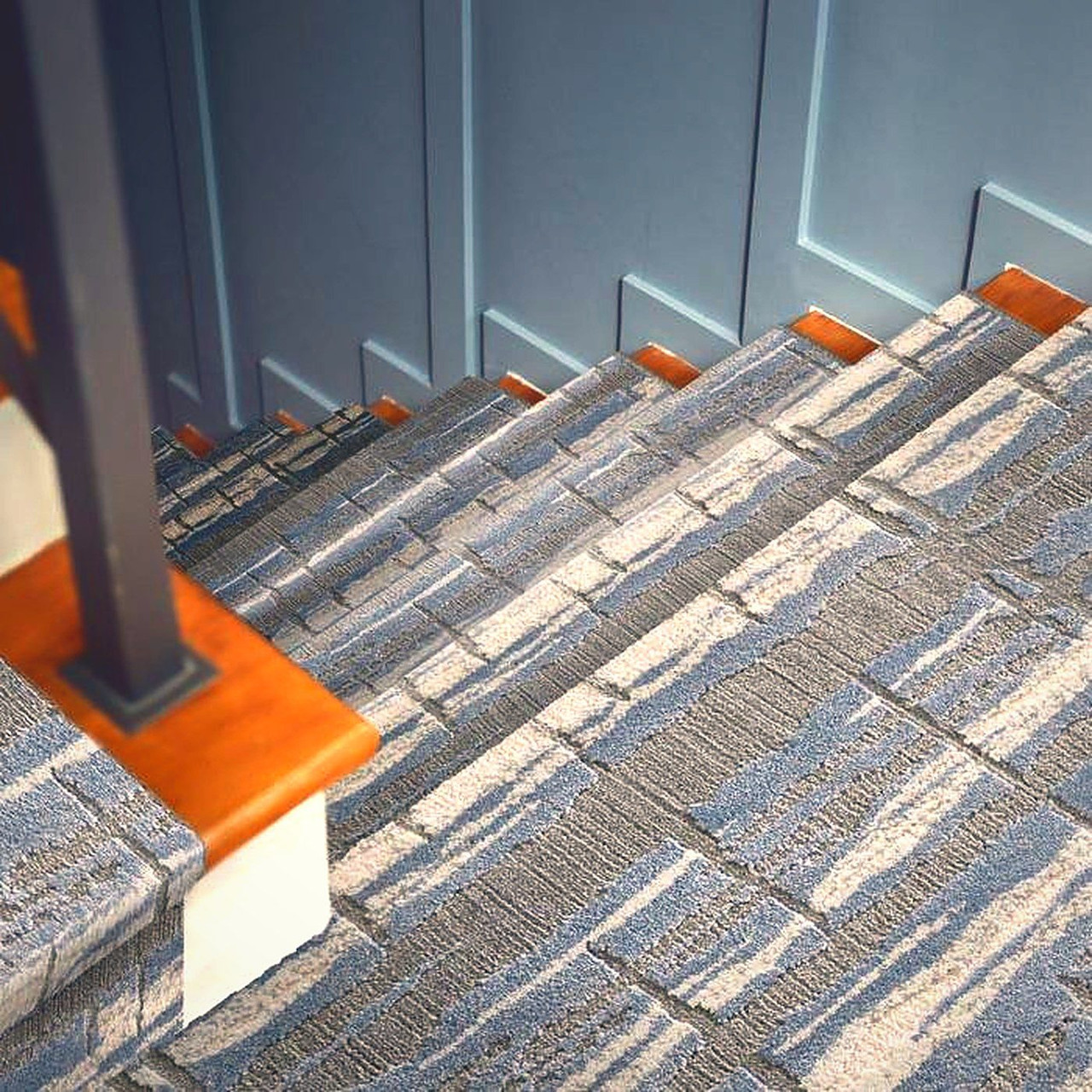
On a curved flight every tread is a wedge: wide at the outside, narrow at the inside. A runner cut from broadloom has to be pieced tread by tread, each piece turned a few degrees from the last, so the pattern matters. Small, organic, non-directional patterns like the one above turn beautifully because no seam has a straight line to betray it. Stripes and strong geometrics fight the turn; if a client wants stripes on a curve, we show them a strike-off of what the inside corner will look like first.
Dense cut pile and Wilton weaves are the right constructions here. The yarn is locked into a woven back, the pile is short enough to bend over the nosing without opening, and the edge takes binding cleanly. Loop pile, which would snag at the nose and show backing on the turn, stays on the straight runs.
Waterfall or Hollywood
Two ways to dress the step. A waterfall install lets the runner fall straight from the nosing to the next tread, held at the back of each step, which shows the nosing's profile and reads a little more relaxed. A Hollywood install wraps the runner tight to the nosing and tacks it under, so the stair edge disappears into the carpet and the lines are crisp. On a curved stair we usually recommend Hollywood: the wrap hides the piecing at the nosing, which is exactly where a waterfall would reveal it.
The pad
A stair pad is cut 2 inches narrower than the runner and stops short of the nosing, so the runner itself wraps the edge and the step stays firm underfoot. It is thin on purpose: 1/4 to 3/8 inch of dense felt or rubber. The 7/16 inch 8 pound rebond that belongs under a bedroom carpet is too soft for a stair; it lets the runner shift and makes the nosing mushy, which is a trip hazard dressed as comfort.
The spiral
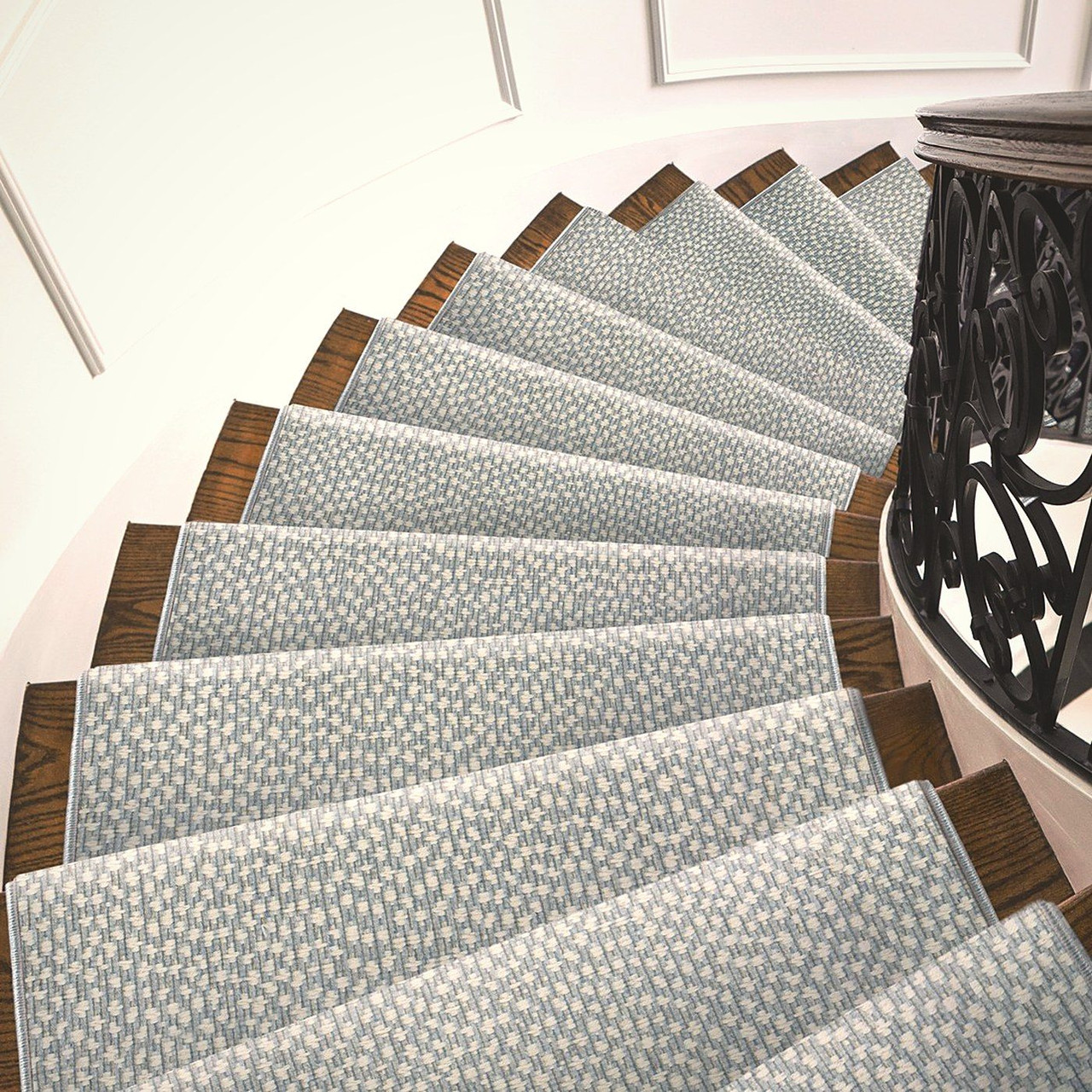
This spiral is the hardest version of the problem: continuous turn, narrow inside treads, and an iron balustrade that leaves no margin on the open side. The answer was an animal print, which turns without a visible seam because there is no repeat to break, and a Hollywood wrap on every step. The reveal, the wood showing on either side of the runner, is narrower than on a straight flight on purpose; on a tight spiral a wide reveal makes the runner look like an afterthought.
The landing
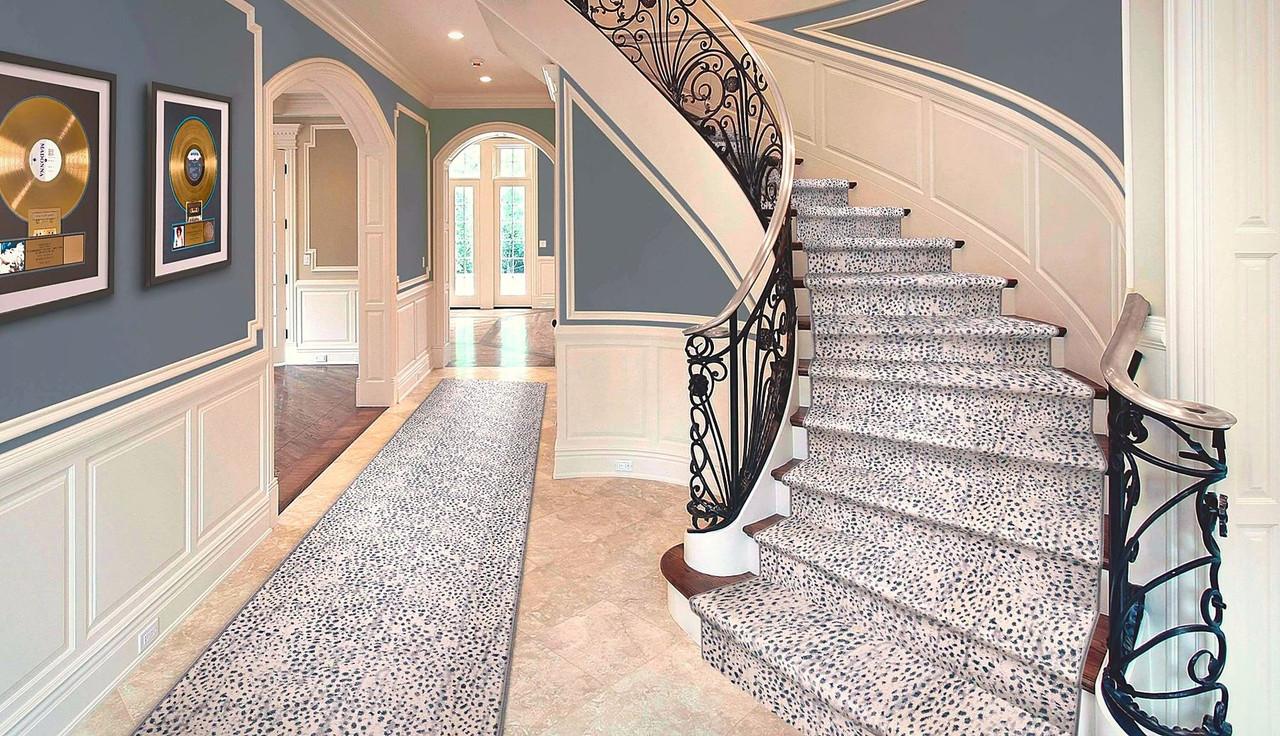
Where a flight turns at a landing the runner can continue as one piece (a single run folded at the turn) or be cut and mitered so the pattern squares to each flight. Mitering costs a seam and buys a pattern that stays square; folding costs the pattern and buys a seamless run. For a patterned runner we miter. In the foyer above the runner also carries on across the hall floor, which is the detail that makes the whole ground floor read as one scheme.
What we need from a designer to quote a curved stair
The number of treads, the number and type of landings and winders, the width of the stair at the narrowest tread, whether the balustrade is open or closed, and the style and width of runner you want. Photographs from the bottom looking up and from the top looking down answer half the questions. With those we can quote the runner, the pad and the install anywhere in the country, and our stair guides cover fiber choice, pad and what to tell the installer in detail.